Is AI an Invasive or Native Species?
AI itself is neither good nor bad. It becomes good or bad through the influence of the environment in which it operates.
It can thrive as a native species does in a healthy habitat, or it can cause all kinds of problems in an environment where the conditions let it get out of control, as an invasive species does in an imbalanced habitat. Everything depends on the environment.
The invasive nuisance
In my recent professional history, I had the privilege to work with the fisheries of the U.S. Fish and Wildlife Service. Of the various programs they had, managing invasive species was among them. Being from the midwest, the problem with Silver Carp stands out to me as one of the most fascinating examples. Imported in the 1970s to control nuisance algal blooms, they escaped confinement and began wreaking havoc in the Mississippi river basin and beyond. In this new environment for the Silver Carp, lacking predators to keep the populations under control, they began multiplying prolifically, consuming food and competing for habitat that native species depend on. What started out as a well-intended solution to a problem turned into a much bigger problem, and the Silver Carp became a nuisance.
What do I mean by being a nuisance? Well, in Peoria, Illinois where the problem is particularly bad, you'll need a football helmet to go waterskiing. Below is an image that shows what it's like when a school of Silver Carp gets frightened, usually by a boat.
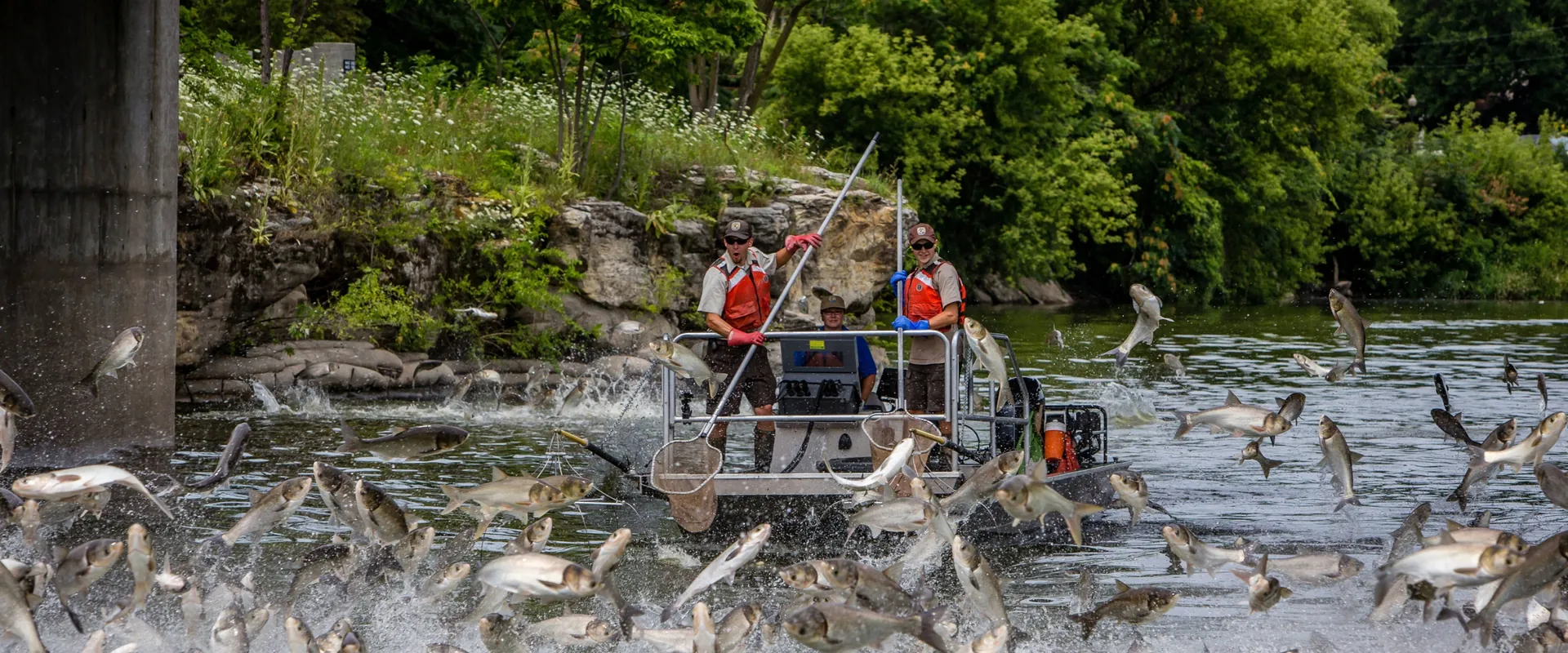 (
(The imposition on recreation might be the most immediate effect to humanly relate to, but the damage these fish do by eating up the food source of native species and thereby threatening their population is the more serious problem.
The thing about invasive species is that they're native from somewhere else. It is the environment that makes their presence and behavior a problem. In their native habitat there's an equilibrium where their populations are under control. Once transplanting a species to an environment where the conditions enhance its characteristics, its capabilities become magnified, overpowering other species in the environment, and the situation gets out of control.
When AI is invasive
When AI is in an environment where it gains an outsized ability to assert power, the situation gets out of control too. When entrusted with systems and information that go unchecked, it can turn into a big mess, like deleting emails with reckless abandon. When AI takes over entry-level tasks, intelligent people lose their jobs. But the loss of intelligent people whose job it is to perform a task also incurs the loss of their creativity and culture they bring with them. In an environment where AI behaves as an invasive species, it will compete for resources and force out the ones who also depend on those resources to do their best work for the organization. It will do things that are not expected. When placed in an environment to solve a probIem locally without consideration for the far-reaching effects, it will introduce a change for which the effects are not carefully considered against the mission of the organization and the design of the whole system.
When introducing AI into work to help solve problems, it is so important to acknowledge the complex environment in which it operates. Tasks relate to people. People relate to culture. Culture relates to quality. Quality relates to customer satisfaction. All of those attributes about work and much more are intertwined. Mess with one, and you mess with the rest without intending to. Just as a natural habitat is complex with organisms and natural resources affecting one another in feedback loops, work in an organization is the same. Introducing a fish to deal with a problem of algal blooms without considering the upstream and downstream effects leads to a eventual damage that may never be remediated. AI is one such powerful force that positions itself as a solution to myriad problems. But if it is introduced in a way that does not conform to the values and mission of the organization through carefully controlled domains of trust, it will run amok.
What does AI look like when it behaves as a native species?
In short, it integrates to produce the outcome directed by the mission of the organization. That's necessarily abstract. Stated in a concrete example, in an organization developing software, AI will accelerate code generation directed by the requirements and judgment of people who are accountable to the health of their company. The ones designing the product define what they need to be for customers, using AI to develop those requirements, but on human terms. AI agents generate code, check code, and manage pipelines. Engineers work with those agents to make sure what's being built adheres to design standards, and inject their expert judgment. It integrates holistically, considering complexity of its introduction. In consideration of long term lifespan of an organization, AI does not replace junior developers, because the long term health of the company depends on having individuals grow into the senior developers who inject their expert judgment. Integrating AI in this way acknowledges complexity by taking time to consider the far-reaching effects on the whole system. AI as a native species brings ideas to life faster by unblocking bottlenecks and integrating into the complex fabric of the organization.
Introducing AI so that it behaves as a native species instead of an invasive one comes down to acknowledgement of complexity. Those who bring in AI to replace this or that without considering the effects of displacement will find themselves with a situation that threatens to get out of control. Those who focus exclusively on the goal of the organization, and use AI to serve that goal by thinking hard about how and why it will improve their systems will win. AI as a native species thrives and improves the health of the whole working habitat.