Finding Meaning on Highway 287
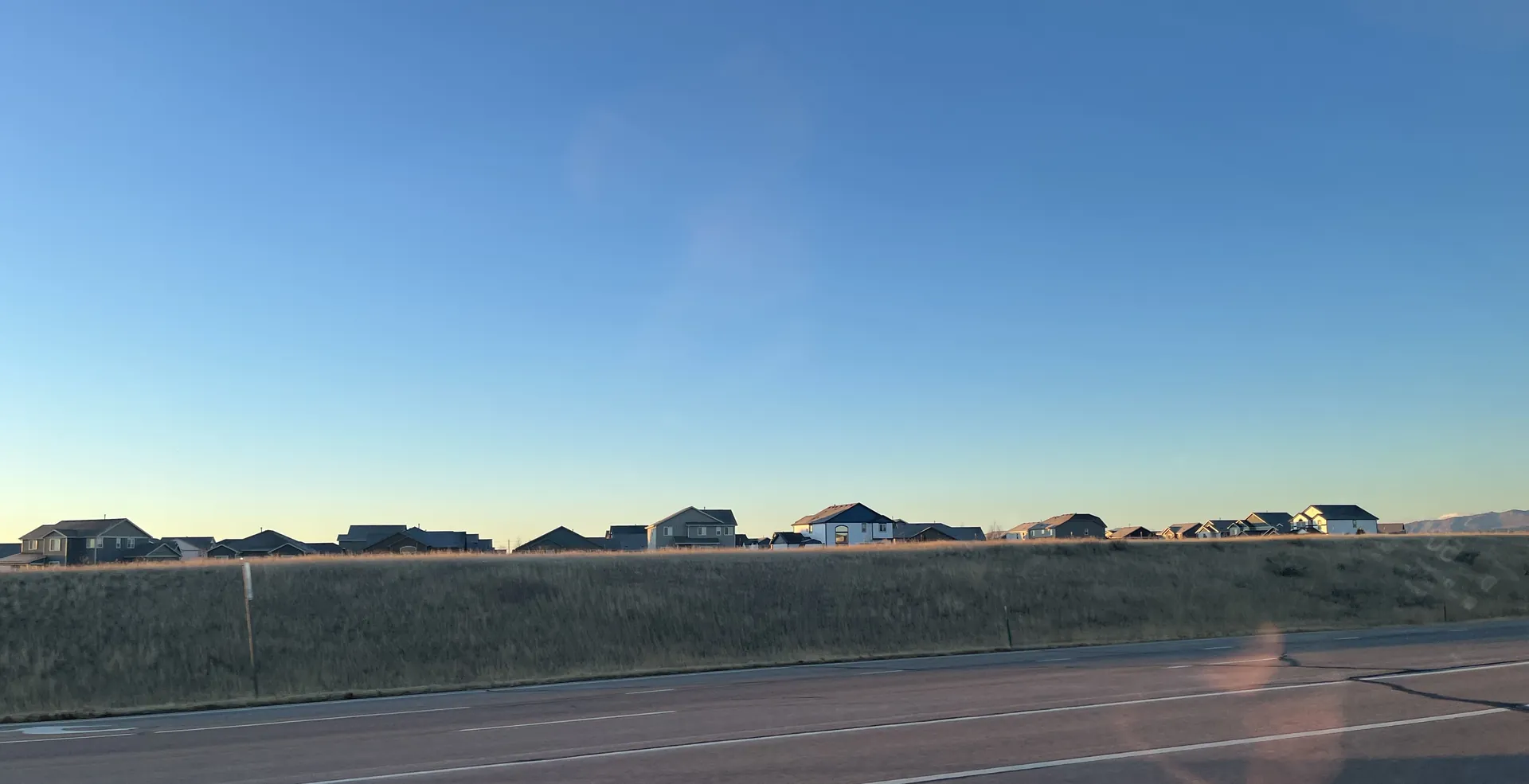
This is the view from the driver's side window looking east on my 70-minute drive to work in the morning. It's a housing development in Berthoud, Colorado that backs up against highway 287. I don't know much about it beyond what you see here. These are relatively newer homes on small lots, packed in tightly. The neighborhood isn't really close to anything more than the highway. Driving past it makes me sad.
It's my imagination of what people's lives are like living in that housing development that triggers the sadness. Being in the relatively remote location means that living there requires driving somewhere else to get to work, and everywhere else for that matter. I checked out Google maps to see what's there, and there's not much. There is a tiny park with a swing set, a slide and a couple of benches. It is one of the most dismal parks I've seen. The houses in the neighborhood are positioned so close together that there's no room for privacy outdoors, and not much room to play in the yard. I'm sure it is an affordable place to buy a home. But mmmm, the compromises in quality of life appear to be very costly.
During my drive into work I contemplate what life might be like for the people living there. Waking up, doing a morning routine, driving to work, then coming home to sit in the house and watch Netflix, go to bed, and do it all over again, ad nauseam. In my imagination, life in this neighborhood is bland, boring, monotonous, and lonely. Needless to say, it's not the kind of place where I want to live.
I have to say, I know that my assessment about this neighborhood and the projection of the lives of those living here isn't fair. I could be totally wrong. Maybe the neighbors living there have great relationships with each other. Maybe the kids play together in the streets. Maybe they have a great book club and neighborhood pot lucks. Maybe they've got a great community filled with laughter and love. I really hope they do have those things. I hope that it just looks bleak.
Going Beyond Just Being Judgy
It's easy to look at the other-over-there and judge harshly. I've learned that judgment based on appearances is always insufficient though. People are complex and nuanced, and I love that. There's always more to the story than meets the eye. With that in mind, I'm keeping my assessment in the realm of imagination only.
The reason that I felt like writing this is not to judge this neighborhood or the people who live there based on its dismal appearance. What I really contemplate on that stretch of highway as I drive into work is life void of meaning. In this neighborhood the appearance of lifelessness is laid bare. And it strikes fear into my own heart. Even though I don't live there, I can see a resemblance that makes me squeamish.
Objectively judging, my own pattern of activity is quite ordinary in its appearance too. I wake up on Monday, do my morning routine, drive to work, come home for dinner with my family, do the dishes, spend an hour on something -- normally useless -- then go to bed. And then I wake up and do it all over again for the rest of the week. I don't know my neighbors well. I don't have pot lucks or book clubs. I may live in a neighborhood that isn't backed up against a noisy highway, but the template of my lifestyle is not very different from the one that repulses me on my morning commute.
Yes, that view out my driver's side window acts like a mirror. I so easily project that life is void of meaning in that housing development because, well, I find myself asking "what am I really doing this for?" on my walk from the parking garage to the front door of the office too. It sounds horrible, but I shake that off pretty easily once I get my perspective rightly fixed.
Adopting Solomon's Perspective
"There's nothing new under the sun", Solomon wrote in Ecclesiastes. He made this observation almost 3,000 years ago, and then followed up with quite a few pithy reflections about life. What he experienced, every generation before and after can relate to. Even though technologies have changed the manner of lifestyle, not much else has really changed. That includes how we feel about work and life.
Solomon expands upon the futility of living a life driven by achievement, because it all fades away, lost to the next generations who take it all for granted. He lamented, agonizing that it was useless to work so hard. Life is vanity he said. In so many words he asks, "what am I really doing this for?" His point? Binding meaning in life to achievement and accumulation of wealth is bound to disappoint. Those things are temporary and fleeting. The tremendous achievement and wealth Solomon produced adds authoritative gravity to these reflections. If he felt this way living in splendor, what hope do the rest of us have in living a satisfying life? It's grim if you stop there.
Fortunately, Solomon offers a resolution that's accessible to everyone. Be present. Take time each day to appreciate the inherent qualities of life. Eat, drink, enjoy the good of your work. Take time to enjoy the people you love. Fear God and keep His commandments. He offers encouragement that there is joy to be found in every life, free from the bondage of achievement by paying attention to the way of life instead of the pursuit of outcomes.
This is a perspective of gratitude that transcends all of the nonsense and futility of achievement without negating the importance of working hard. Solomon also makes the point that whatever we choose to do, we ought to do it with all our might, even though the product of that hard work is futile! Isn't that interesting. What we do is valuable, but the value is not found in the product of achievement. The value of our work is the way in which we do it.
What's beautiful about this perspective is that it becomes possible to find meaning in the most grim of circumstances. Meaning is found in the moments expressing our honest agency at full throttle. When I face a day that I'm not really all that excited about for whatever reason, the grimness fades entirely when I treat the tasks of the day as an opportunity to express my own character and values, making decisions about how to do the work in front of me with my own style. When I have my head screwed on straight, I find meaning when I treat work as the medium with which I compose life as a work of art.
When imagining life of those who grind day in and day out, living in a bleak tree-less neighborhood backed up against the highway, I project a life lacking true joy. I imagine myself in that lifestyle too, facing each day asking, "What is it all for?", just like Solomon in his assessment that life is a vain pursuit. Even when life is on the other end of the spectrum, splendored with abundance, the question is just as important.
What I realize is that question is a trap. Answering it on its own terms, measured in achievements, will never deliver lasting satisfaction. "More" is insatiable and "nothing" is self-destructive. However, the question is important, not for its answer, but because it forces contemplation on the reason for being. I am reconciled to believe that life can be full merely through the expression of values (preferably virtuous ones), working hard from that foundation for every opportunity that presents itself.